

AI interview automation uses software to schedule, screen and run first-round interviews. For employers, the main benefits are faster time to hire, far less scheduling work, more consistent questions, 24/7 access for candidates and better records for decisions. It works best early in the funnel. Final decisions, technical vetting and fit still need trained people.
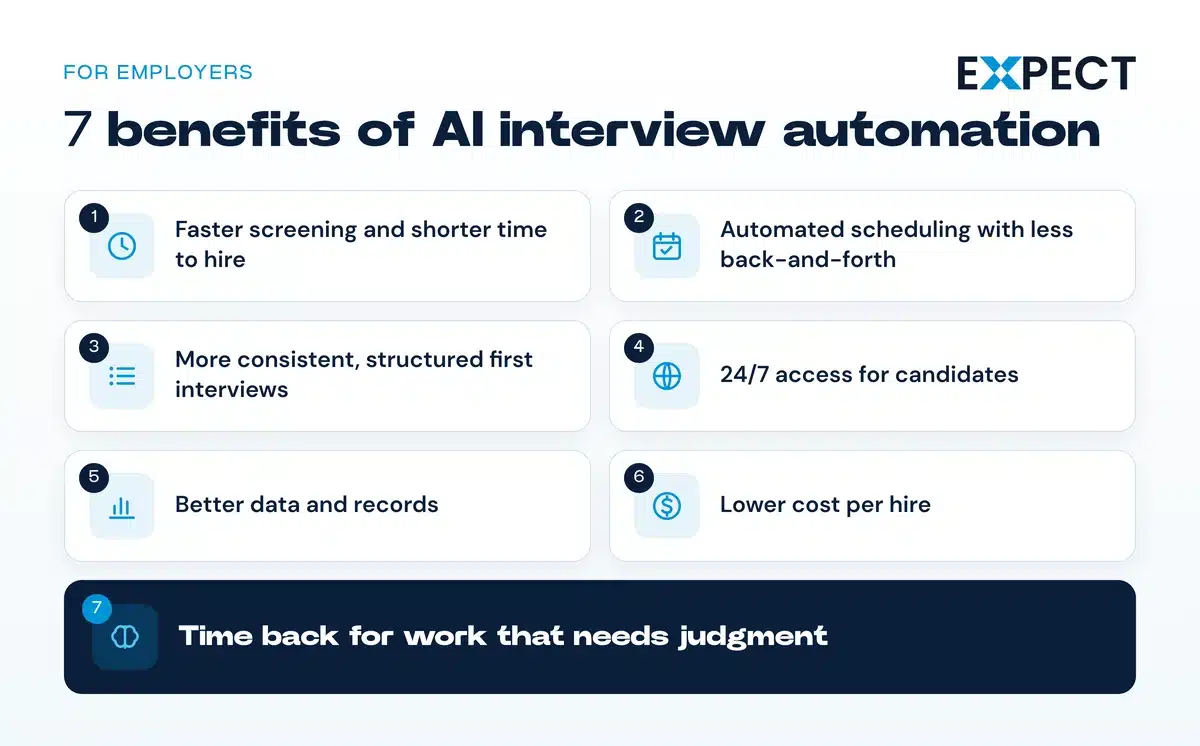
The seven benefits of using AI for candidate interview automation:
- Faster screening and shorter time to hire
- Automated scheduling with less back-and-forth
- More consistent, structured first interviews
- 24/7 access for candidates
- Better data and records
- Lower cost per hire
- Time back for work that needs judgment
For HR leaders and hiring managers, by Chris Specht, Founder and Senior Technical Recruiter at EXPECT.
What Is AI Candidate Interview Automation?
AI candidate interview automation is software, often using NLP and large language models, that schedules, runs, records and summarizes early-stage interviews. It covers:
- Self-scheduling links
- Chat or text screening
- Asynchronous video interview: a one-way interview candidates record on their own time
- AI voice interview: an AI agent asks questions by voice
- Transcripts and scoring against set criteria
7 Benefits of Using AI for Candidate Interview Automation
1. Faster screening and shorter time to hire
AI cuts the waiting between steps. SHRM’s 2025 benchmarking found screening and interviewing each average 8 to 9 days. An AI screening interview runs at any hour, so no one waits for a recruiter.
2. Automated scheduling with less back-and-forth
Self-scheduling ends the email chain. Automated interview scheduling lets candidates pick an open slot. Slow steps cost hires. Gartner found only 51% of candidates accepted an offer in 2Q25, down from 74% in 2Q23. Gartner did not blame scheduling alone.
3. More consistent, structured first interviews
Every candidate gets the same questions. A structured interview uses the same job-related questions and scoring scale for everyone. Sackett et al. (2022) found structured interviews had the highest mean validity (.42). AI delivers that script every time. See structured vs unstructured interviews.
4. 24/7 access for candidates
Candidates can interview on their schedule. In a 2025 field experiment, 78% of applicants offered a choice picked the AI interviewer. But Greenhouse found 38% of US candidates withdrew from a hiring process that included an AI interview. Candidate drop-off is real, so tell people up front.
5. Better data and records
Each interview leaves a clear record. Transcripts and scorecards flow into your ATS. Records matter: California requires four years, and Colorado three once its duties begin.
6. Lower cost per hire
Less manual work can lower cost per hire. SHRM’s 2025 benchmarking put the average at $5,475 for non-executive hires. SHRM did not measure AI savings, and a cheap hire that fails saves nothing.
7. Time back for work that needs judgment
Recruiters get hours back for judgment calls. That time goes to technical vetting, calibration and closing, and it eases recruiter burnout.
Hiring engineers, technicians or developers? EXPECT pairs fast screening with recruiters who know the work. Talk to a technical recruiter
What Does the Research Actually Show?
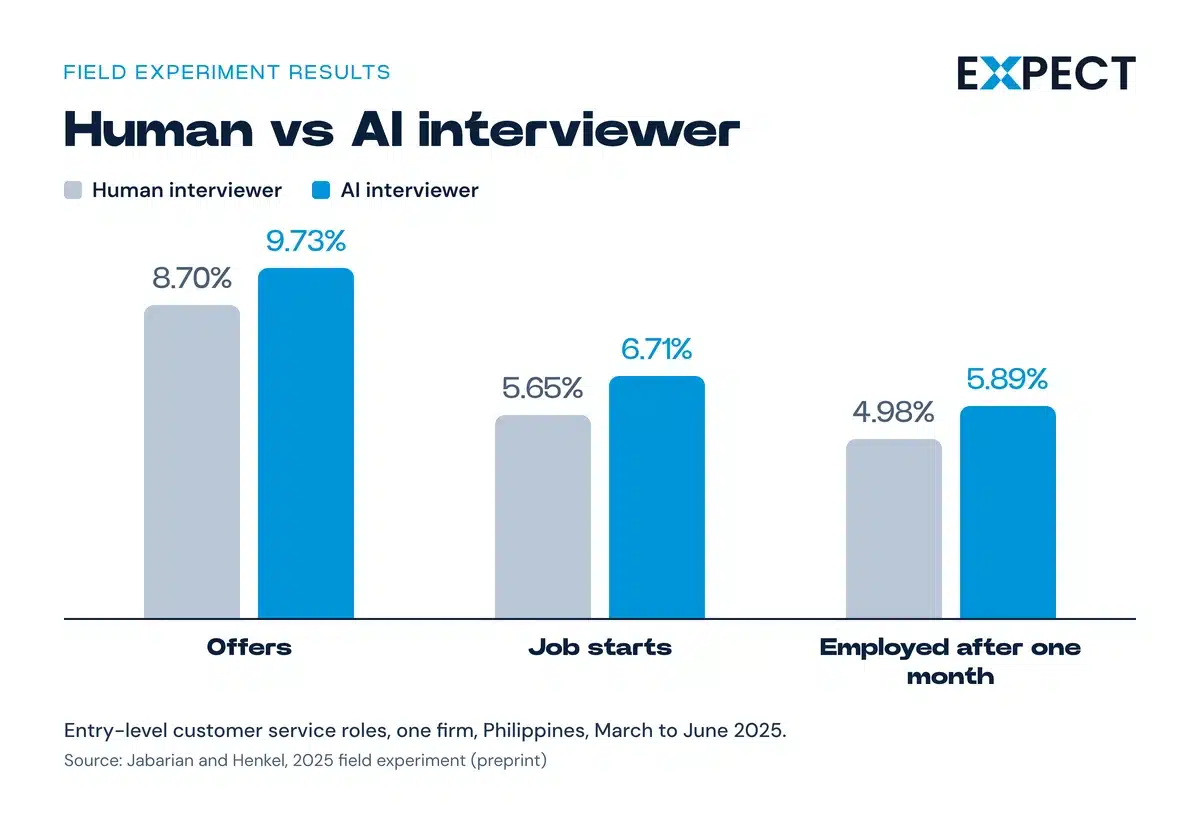
Jabarian and Henkel ran a field experiment with 70,884 job applications from March to June 2025. Versus human interviewers, AI voice interviews led to 12% more offers, 18% more job starts and 18% higher one-month retention. Human recruiters made every hiring decision.
Scope matters: all were entry-level customer service jobs at one firm in the Philippines. It is a preprint, and no comparable data exists for engineers or senior roles.
What Are the Limits and Risks?
- Bias is not removed. Greenhouse found US candidates report nearly the same perceived bias from AI and human interviewers. A federal court let Mobley v. Workday, an age discrimination suit over AI screening, proceed as a collective action in 2025. HireVue dropped facial analysis in 2021.
- Trust is low. Gartner found only 26% of candidates trust AI to evaluate them fairly. Pew found 66% of US adults would not apply where AI helps decide. Greenhouse found 70% of US candidates were not clearly told AI was used.
- Technical depth is missing. An AI screen can confirm a candidate used Kubernetes. It cannot judge how they reason through an outage. [QUOTE FROM CHRIS: technical vetting example] That takes engineering recruiters who vet technical skills and a real technical interview.
- Fraud is rising. Gartner found 6% of candidates admitted to interview fraud. It predicts one in four candidate profiles will be fake by 2028 (a prediction, not a count). The fix is a live technical conversation, which our software developer recruiters run.
Which AI Interview Laws Apply to Employers in 2026?
General information, not legal advice. New York City calls these tools AEDTs, or automated employment decision tools.
| Law | What employers must do | Status |
| NYC Local Law 144 | Independent bias audit, public summary, candidate notice | Enforced since Jul 2023 |
| Illinois AI Video Interview Act | Notice, explanation and consent before AI analyzes video; delete on request | In force since 2020 |
| Illinois P.A. 103-0804 | No AI with discriminatory effect; no zip code proxies; notice | From Jan 1, 2026 |
| Colorado SB 26-189 | Notice, adverse-decision explanation, human review, 3-year records | Duties from Jan 1, 2027; enforcement on hold |
| California ADS rules | Anti-discrimination applies to automated systems; 4-year records | Since Oct 1, 2025 |
| Title VII and UGESP | Disparate impact still applies; four-fifths rule | EEOC AI guidance withdrawn Jan 2025; law unchanged |
Where Do AI Interviews Fit by Role Type?
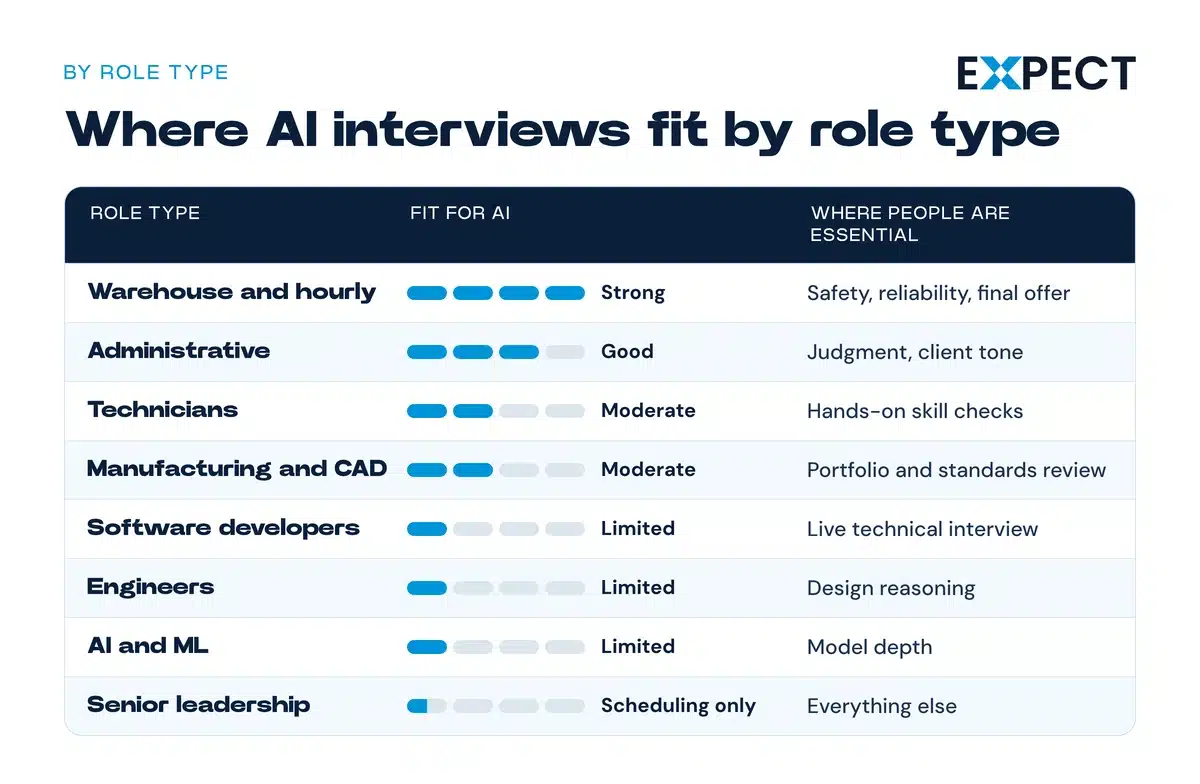
| Role type | Good fit for AI? | Where people are essential |
| Warehouse and hourly | Strong | Safety, reliability, final offer |
| Administrative | Good | Judgment, client tone |
| Technicians | Moderate | Hands-on skill checks |
| Manufacturing and CAD | Moderate | Portfolio and standards review |
| Software developers | Limited | Live technical interview |
| Engineers | Limited | Design reasoning |
| AI and ML | Limited | Model depth; AI and machine learning recruiters |
| Senior leadership | Scheduling only | Everything else |
Specialised role that AI can’t vet? Contract, contract-to-hire or direct hire, nationwide. Tell us about your role
How Should You Roll Out AI Interview Automation?
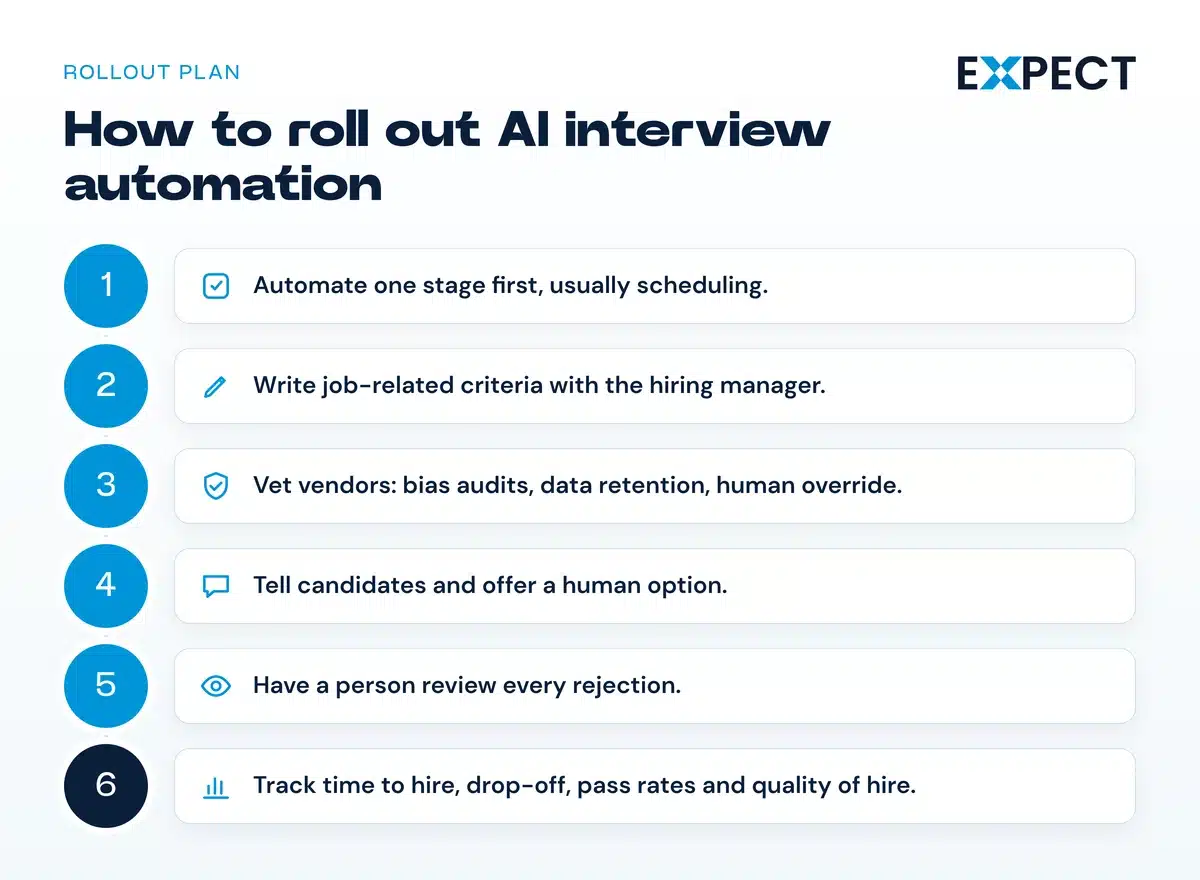
- Automate one stage first, usually scheduling. Contract recruiters can cover gaps.
- Write job-related criteria with the hiring manager.
- Vet vendors: bias audit results, transcript vs video scoring, data retention, accommodations and human override.
- Tell candidates, offer a human option and close the loop with everyone.
- Have a person review every rejection.
- Track time to hire, candidate drop-off, pass rates by group (four-fifths rule) and quality of hire. Only 20% of organizations track quality of hire, per SHRM.
Benefits of AI Interview Automation FAQs
Do AI interviews replace recruiters?
No. In the largest field study, human recruiters made every hiring decision while AI ran the first interview. People still judge technical depth, team fit and close calls. Use AI to free your recruiters from scheduling and repeat screens, not to replace them.
Is it okay to use AI for an interview?
Yes, with conditions. Tell candidates AI is being used, get consent where the law requires it, run bias audits and keep people in charge of every decision. Rules vary by state and city, so check the laws where you hire before you launch.
How can AI be used in HR recruitment?
AI works best early in the hiring process. Use it for self-scheduling, chat screening, one-way video or voice interviews and transcripts. Leave technical vetting, fit and offers to experienced people. Start with one stage, measure time to hire and drop-off, then expand.
Are AI interviews legal in Colorado?
Yes. Colorado’s SB 26-189 requires notice, an explanation of adverse decisions, human review and three years of records, with duties starting January 1, 2027. Enforcement is on hold, and the law has changed more than once, so check its status before you launch.
Speed Up Hiring Without Losing Judgement
Use AI for scheduling and early screens. Keep people on technical vetting, fit and the final call.